
TL;DR
- Order-wise packing follows the order list, so the packer keeps going back to the same rack whenever a SKU repeats.
- SKU-wise packing counts each SKU first, picks the full quantity once and packs all its orders together.
- With 30 orders spread over 5 SKUs, that is 5 rack trips instead of up to 30.
- You need a picklist, SKU-wise quantities and printed labels, ideally sorted by SKU.
- Multi-SKU orders go in their own pile, packed at the start or the end.
- In a real clothing example, 24 orders across 5 size and colour SKUs become one picklist of 30 units and 5 picks.
- At hundreds or thousands of orders, process every account and marketplace in one place and pack batch by batch from SKU-sorted labels.
- HappySellers builds the SKU-wise picklist and sorts your labels by SKU, so the method is ready before your team starts packing.
The orders are in, the labels are printed and the courier pickup is a few hours away. Then packing starts, and it takes much longer than it should.
Most of the time, the problem is not the people. It is the order in which they pack.
This guide explains SKU-wise packing with a real clothing example, the common mistakes, multi-SKU orders and high volumes. It is for small sellers packing at home and full warehouse teams alike.
The problem with packing order by order
Most sellers pack the way the orders arrive: first order, find the product, pack it, label it, then the next. With a few orders a day it works. The trouble starts when the same SKU appears in many orders.
Most sellers keep their stock organised by product. All units of one SKU sit on one rack or shelf, the next SKU sits on the next rack, and so on. Orders, however, do not arrive in rack order. The first order might be for SKU 1, the second for SKU 2, and the third for SKU 1 again.
So the packer walks to the SKU 1 rack, then SKU 2, then back to SKU 1, picking the same product again and again, one unit at a time.
Every trip costs time and effort. Order-wise packing does not, by itself, make orders go missing. Its real cost is the repeated walking, and on a busy day that adds up fast.
What SKU-wise packing means
A SKU (stock keeping unit) is the code a seller uses to identify one exact product, for example one design in one size and one colour. Each seller creates its own SKUs, so two sellers can use different codes for the same item.
SKU-wise packing flips the order of work: you follow the product list, not the order list. Count the units SKU 1 needs, collect them in one trip, pack its orders one by one, then move to SKU 2.
Large warehouses use the same idea under the name batch picking: grouping orders that share the same items so pickers make fewer trips. SKU-wise packing carries that grouping all the way through printing and packing.
A worked example: 30 orders and 5 SKUs
Take a simple day. You have 30 orders and 5 SKUs: SKU 1, SKU 2, SKU 3, SKU 4 and SKU 5. Each SKU appears in 6 orders, and each SKU sits on its own rack.
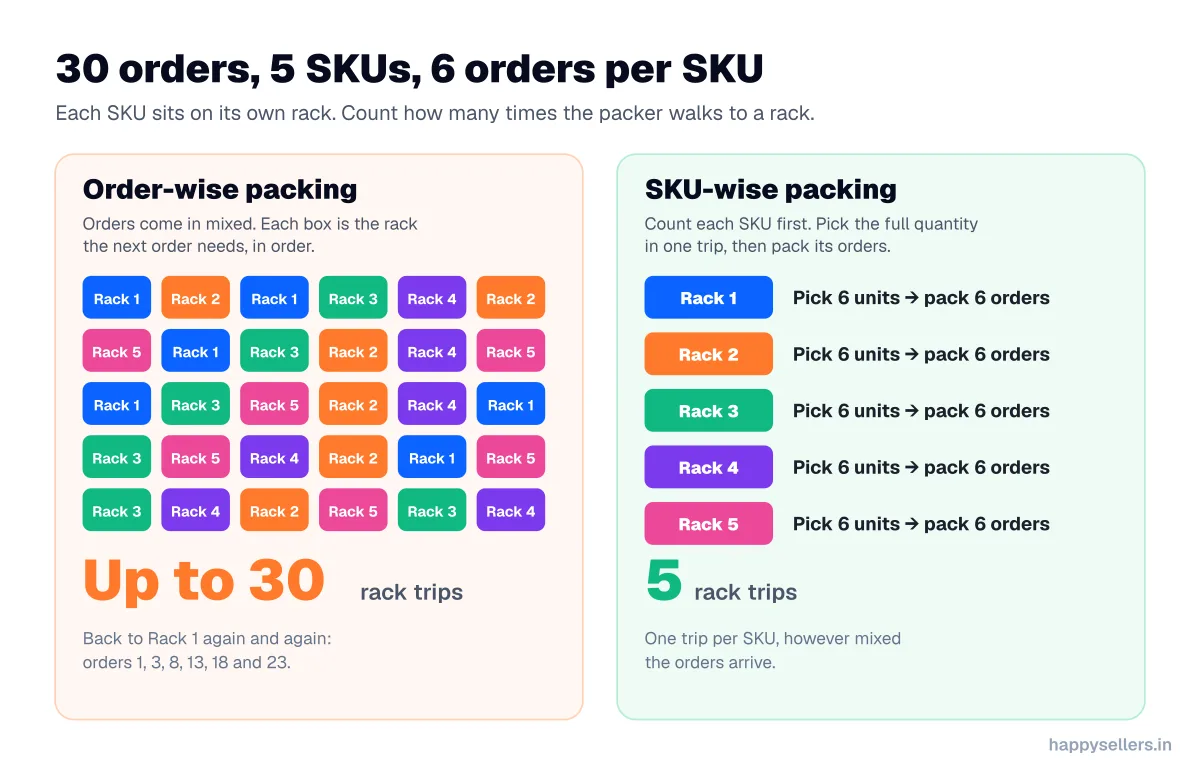
Order by order. The orders come in mixed. You cannot expect all the SKU 1 orders to come first. In the example above, the packer goes to Rack 1 for order 1, Rack 2 for order 2, back to Rack 1 for order 3, and so on. Because the orders are mixed, that can mean up to 30 rack trips, and the packer returns to Rack 1 six separate times.
SKU by SKU. You first check how many orders need each SKU. SKU 1 is in 6 orders, so you collect 6 units from Rack 1 in one trip and pack those 6 orders one after another. Then you do the same for SKU 2, SKU 3, SKU 4 and SKU 5. That is 5 rack trips in total, one per SKU, however mixed the orders were.
Stop counting SKUs by hand. HappySellers builds your SKU-wise picklist and sorts your shipping labels by SKU in one click, so your team walks to each rack once. Start free with HappySellers — free trial credits, no card required.
A real example: a clothing seller with 24 orders
Real orders are messier than the 30-order example. Take a clothing seller with one T-shirt design. Every colour and size is its own SKU, because a black M and a black L are different products. Today’s orders use five: TEE-BLK-M, TEE-BLK-L, TEE-WHT-M, TEE-WHT-L and TEE-NVY-S.
Twenty-four orders came in overnight, in no particular order. Twenty contain one SKU each (one of them asks for two black M T-shirts). Four are multi-SKU orders with two or three different T-shirts.
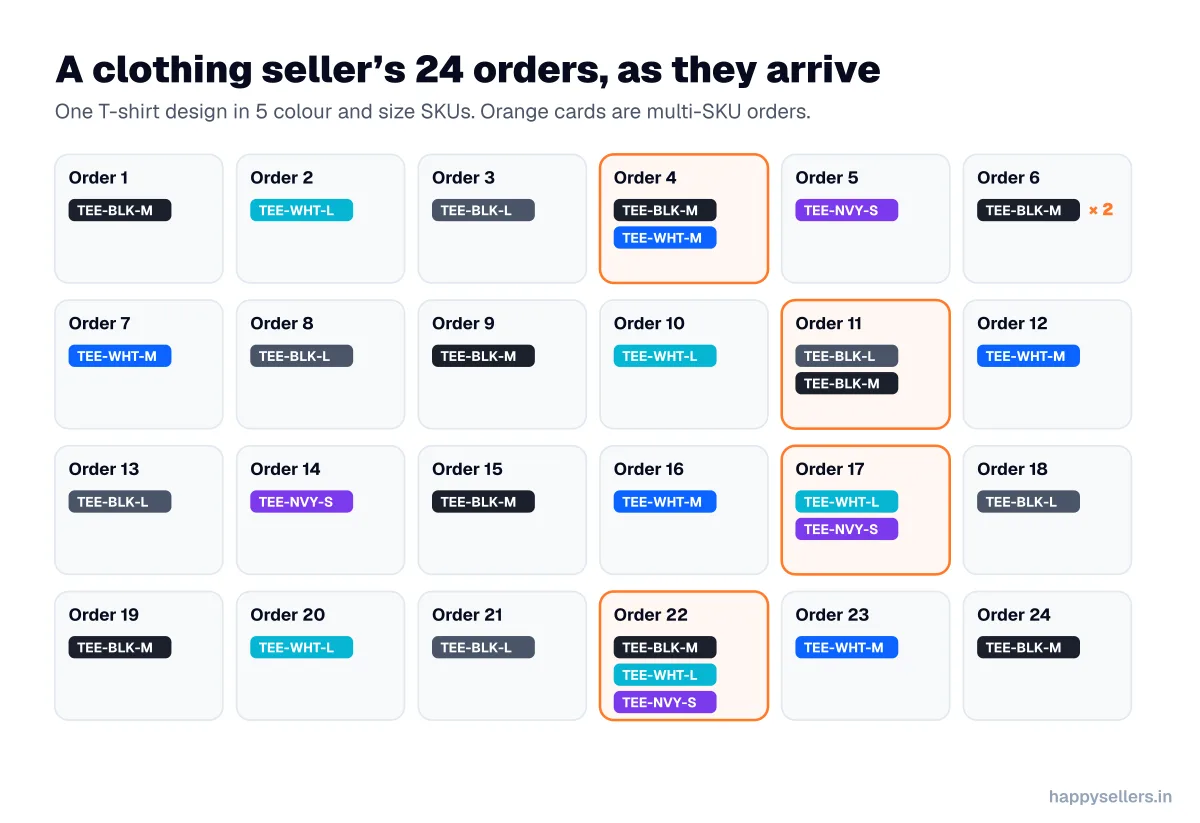
Packed order by order, that is about 29 shelf visits. Here is the same morning, SKU by SKU.
Step 1: Set the multi-SKU orders aside. Orders 4, 11, 17 and 22 go in their own pile. That leaves 20 single-SKU orders.
Step 2: Count each SKU across all 24 orders, multi-SKU orders included. This is your picklist.
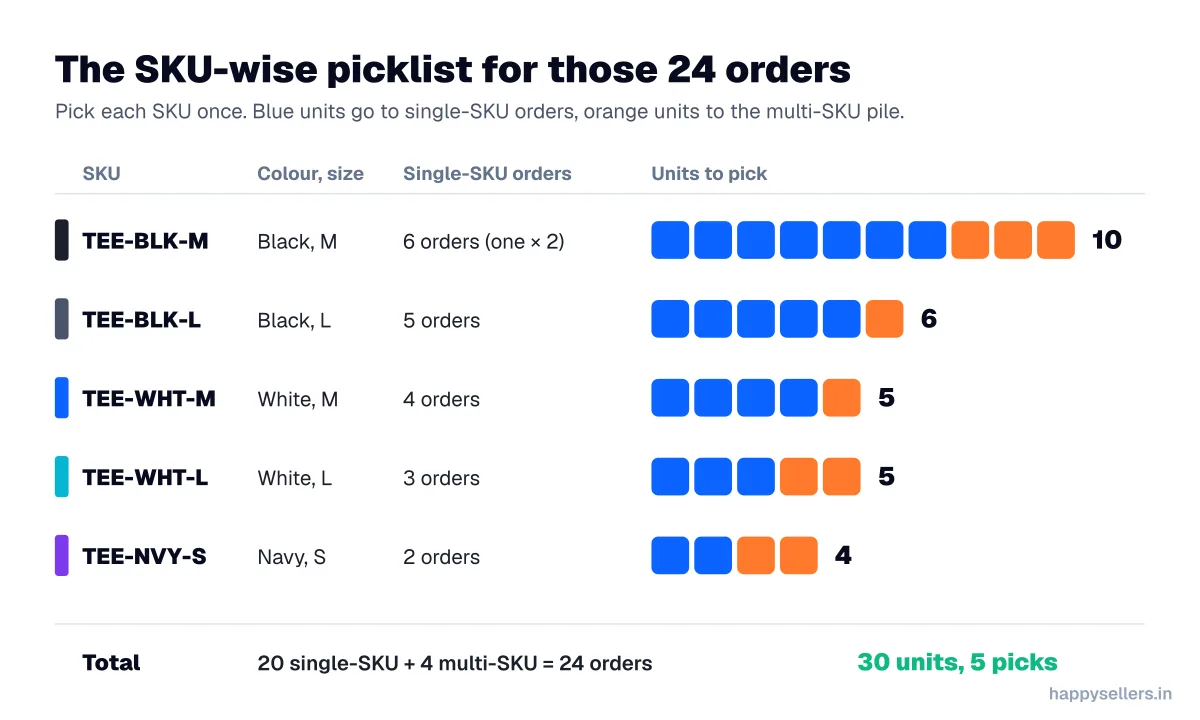
Step 3: Pick each SKU once. Go to the black M shelf and take 10 units: 7 for the single-SKU orders (remember, one order needs two) and 3 for the multi-SKU pile. Then 6 black L, 5 white M, 5 white L and 4 navy S. That is 5 picks instead of about 29 shelf visits.
Step 4: Pack the single-SKU stacks. Pack the six black M orders one by one, with two T-shirts in the order that asks for two. Then black L, white M, white L and navy S.
Step 5: Pack the multi-SKU pile. After the single-SKU stacks, exactly 9 units should be left on the table: 3 black M, 1 black L, 1 white M, 2 white L and 2 navy S. That is exactly what orders 4, 11, 17 and 22 need. Pack them one by one, checking every item against its label.
Step 6: Check what is left. When the last parcel is sealed, there should be no T-shirt and no label left over. A leftover T-shirt means a box is short; a leftover label means a parcel is missing. Because you pick exact totals, mistakes show up now, not when the customer complains.
What you need before you start
SKU-wise packing works only if you know, before packing begins, how many units of each SKU you need and which label goes with which parcel. You need three things:
- A picklist. A list of every SKU in today’s orders.
- SKU-wise quantities. How many units of each SKU the orders need, so you can pick them in one trip.
- Printed labels. The shipping labels for all orders, printed before packing starts. They work best sorted in the same SKU order as the picklist, so the stack of labels matches the stack of products in front of the packer.
Some marketplaces give you SKU quantities and some do not; where they do not, sellers count by hand. Flipkart and Meesho print the SKU on the shipping label. Not every marketplace does, and there sellers match each label to its product themselves, often with their own sheet. That matching is slow and easy to get wrong.
SKU-wise packing, step by step
Here is the full method, from new orders to courier handover.
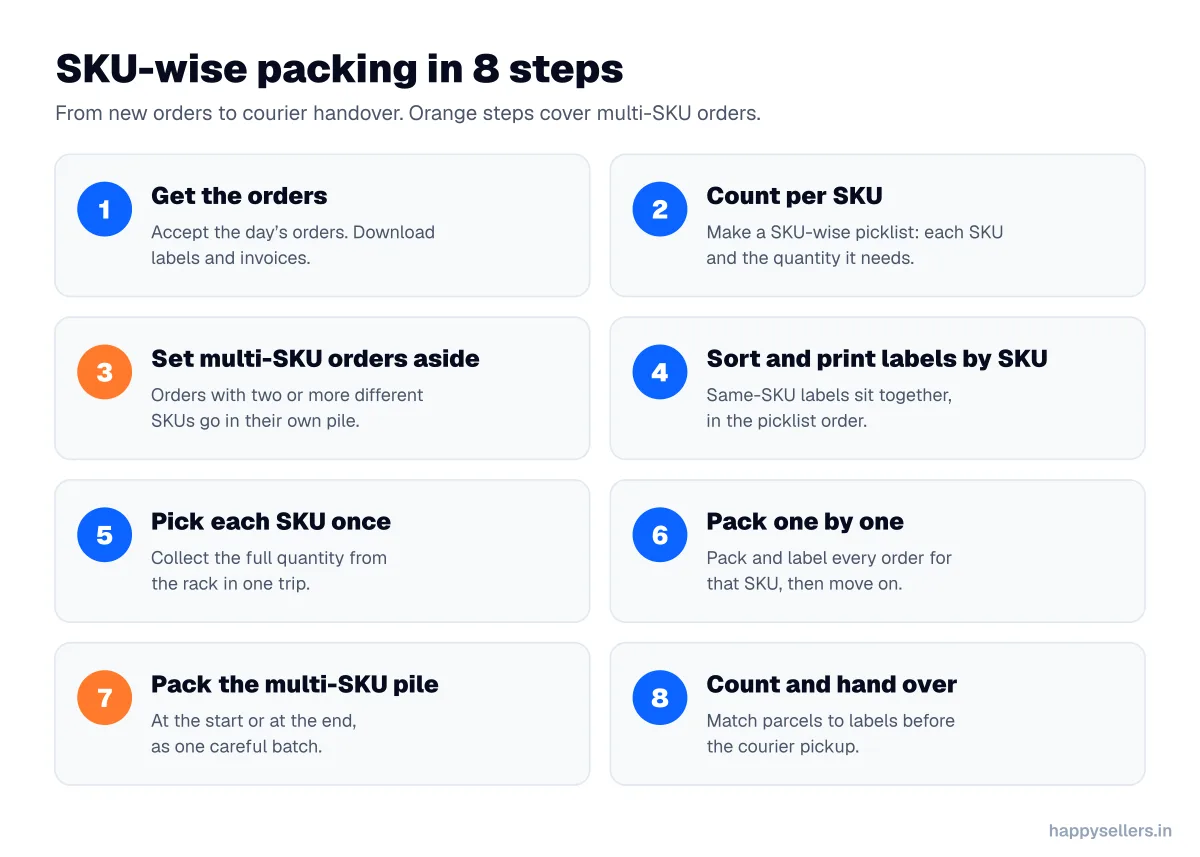
- Get the orders and download labels and invoices.
- Count per SKU in a SKU-wise picklist.
- Set multi-SKU orders aside in their own pile.
- Sort and print labels by SKU, in picklist order.
- Pick each SKU once, the full quantity in one trip.
- Pack one by one, then move to the next SKU.
- Pack the multi-SKU pile, first or last.
- Count and hand over to the courier.
What about orders with more than one SKU?
Some orders contain two or more different products. Sellers often call these multi orders or multi-SKU orders. They need a little extra care, because the items in one box come from different racks.
Their units are already part of each SKU’s total, so you pick them in the same trips. Only the packing differs.
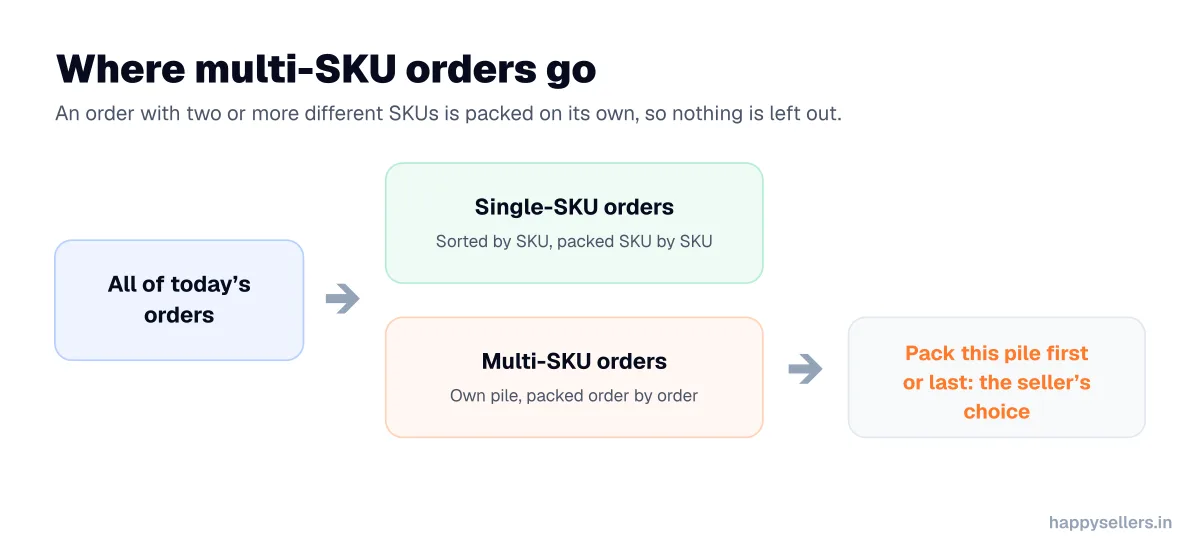
Pack multi-SKU orders separately. Keep them in their own pile and pack them order by order, so the packer checks every item against the label and no product is left out. Where the label shows the SKUs, the packer follows the label. Where it does not, the seller has to match the items by hand.
First or last is your choice. Some sellers clear the pile at the start, others at the end. Both work, as long as multi-SKU orders never mix into the SKU stacks.
Common SKU-wise packing mistakes and how to avoid them
A few mistakes can still creep in, mostly from rushed preparation or products that look alike.
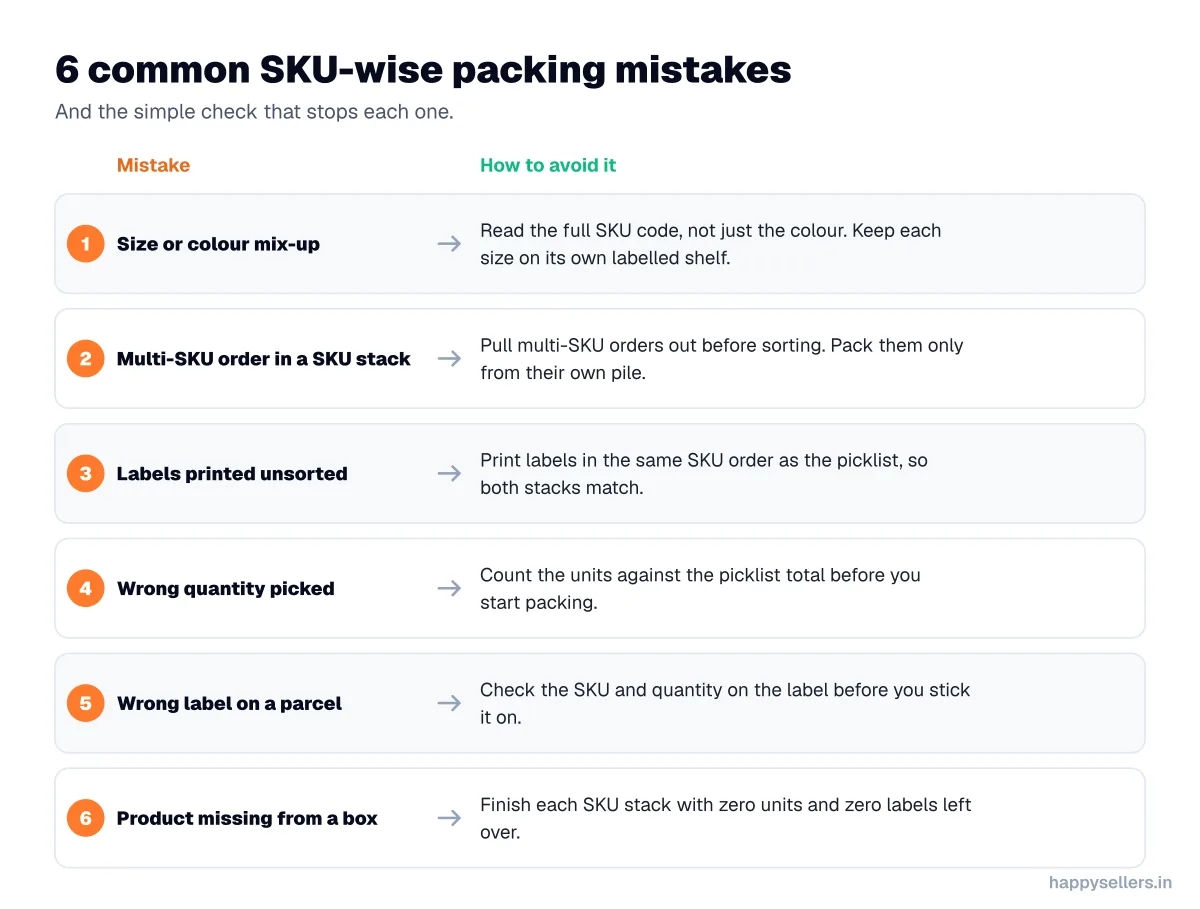
- Mixing up sizes or colours. A black M and a black L look alike in a pile. Avoid it: keep each size and colour on its own labelled shelf and read the full SKU code, not just the colour.
- Multi-SKU orders slipping into SKU stacks. That parcel ships with only one of its items. Avoid it: pull multi-SKU orders out before sorting the labels.
- Printing labels unsorted. The packer hunts for the right label for every parcel. Avoid it: print labels in the picklist’s SKU order.
- Picking the wrong quantity. Too few and an order has nothing to ship; too many hides a missed order. Avoid it: count picked units against the picklist total, and watch for orders that ask for two or more of one SKU.
- Wrong label on a parcel. Easy to do at speed. Avoid it: check the SKU and quantity on each label before you stick it on; where the label has no SKU, check your picklist or sheet.
- A product missing from a box. Most likely in multi-SKU orders. Avoid it: finish every stack with zero units and zero labels left over, and check multi-SKU orders item by item.
When order-wise packing is just as good
SKU-wise packing saves time only when the same SKU repeats across orders. If nothing repeats, there is nothing to group.
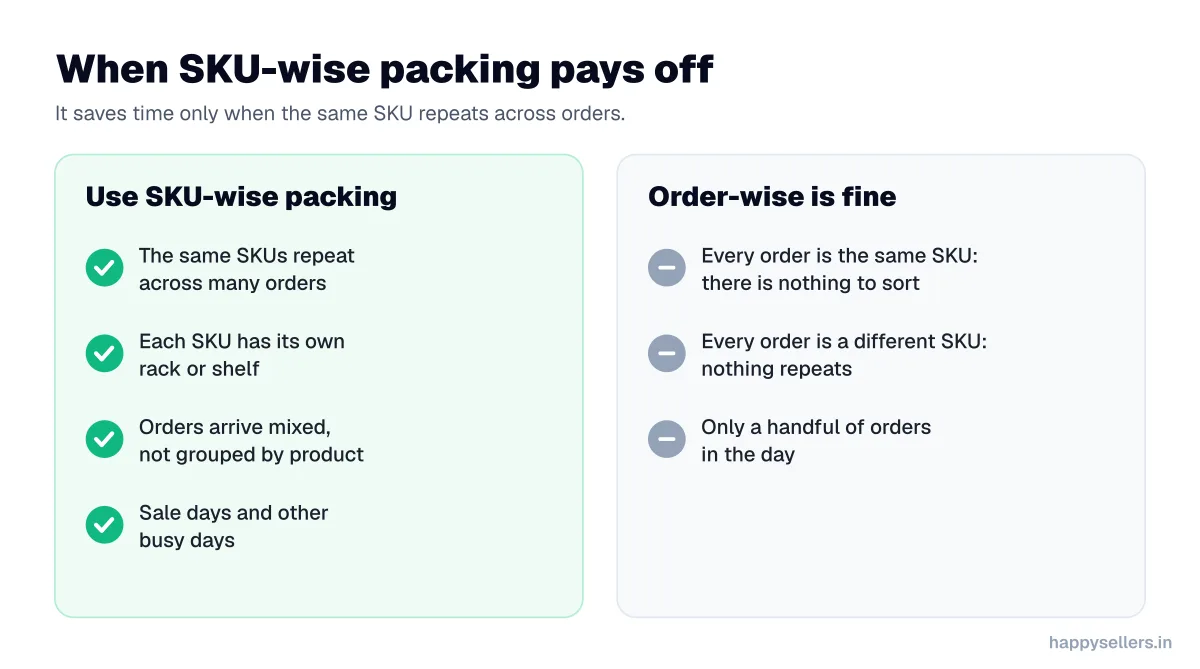
Order-wise packing is perfectly fine when:
- Every order is the same SKU. There is nothing to sort.
- Every order is a different SKU. Nothing repeats.
- You have only a few orders. Planning by SKU may take longer than it saves.
For everyone else, and especially on sale days when the same best-sellers appear in order after order, SKU-wise packing is the faster way to work. Our guide to the Flipkart, Amazon and Myntra sale season explains why sale days put so much pressure on packing teams.
SKU-wise packing for hundreds or thousands of orders
The more orders you have, the more often the same SKUs repeat, and the more SKU-wise packing saves. What breaks at high volume is the preparation: counting SKUs and sorting labels by hand works for 30 orders, not for thousands across several marketplaces and accounts.
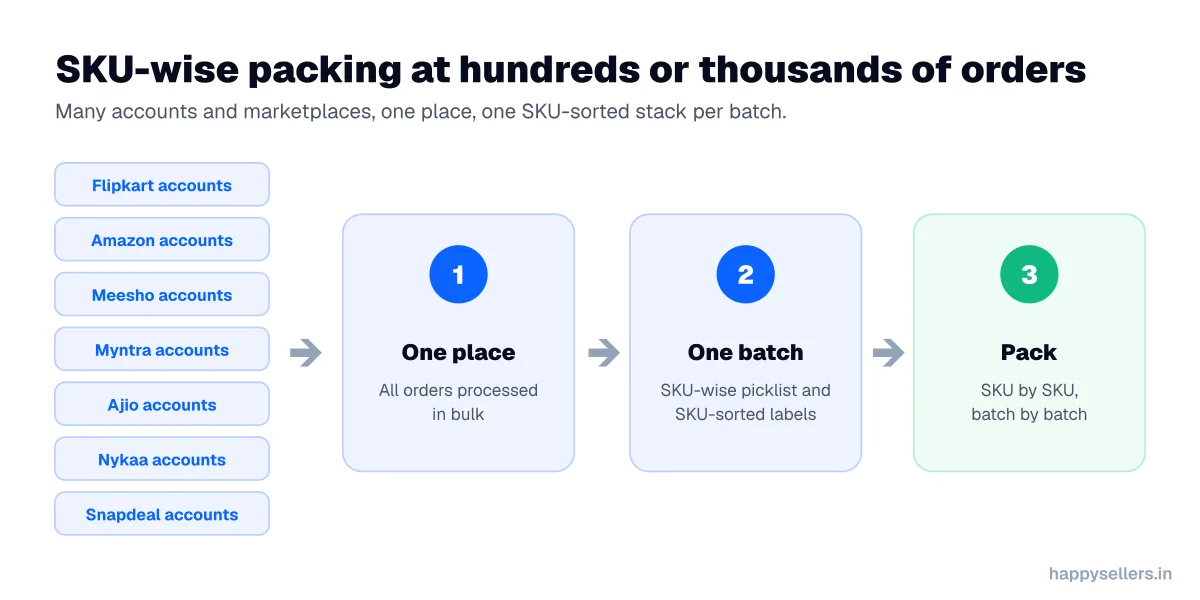
- Process in bulk, not one by one. Take a whole set of orders at once and get all their labels and invoices together, so you print once.
- Bring every account and marketplace into one place. One routine for the day instead of one per marketplace panel.
- Work in batches. Each batch gets its own SKU-wise picklist and label stack, so packers know where it starts and ends.
- Print labels already sorted by SKU. Hundreds of labels cannot be sorted by hand. Sorted labels let packing start the moment printing ends.
Our guide to bulk processing Flipkart smart orders shows what this looks like for one marketplace, and the how HappySellers works page covers bulk processing and multiple accounts in plain words.
A thousand orders should not mean a thousand trips. HappySellers processes orders from all your Flipkart, Amazon, Meesho, Myntra, Ajio, Nykaa and Snapdeal accounts in one place, in bulk, and hands you SKU-sorted labels for every batch. Create your free HappySellers account and pack your next sale day SKU by SKU.
How HappySellers does the hard part for you
HappySellers is order processing software for marketplace sellers on Flipkart, Amazon, Myntra, Meesho, Ajio, Nykaa, Snapdeal and more. SKU-wise packing is built into how it prepares your orders.
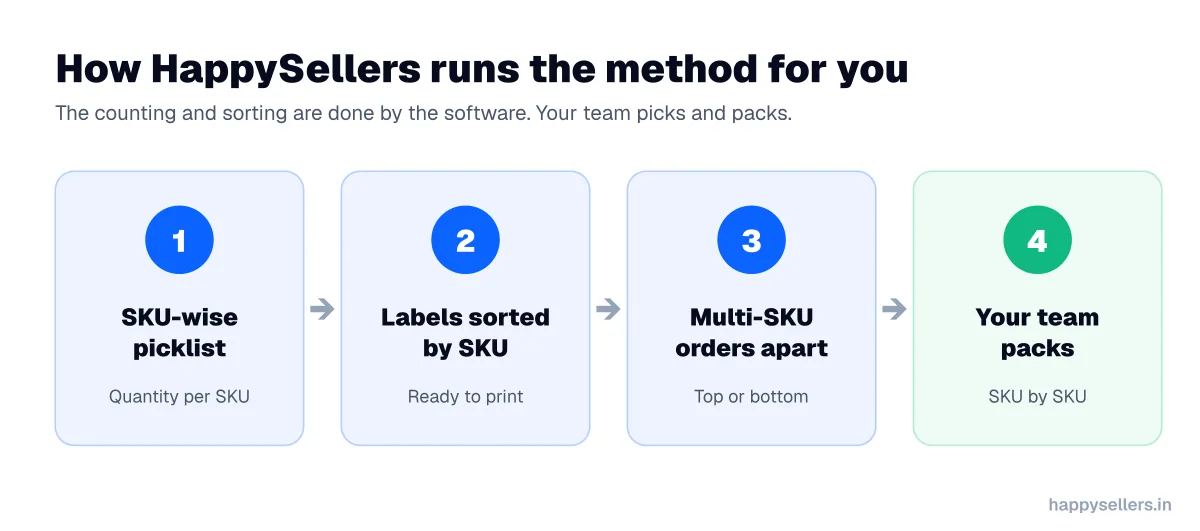
- SKU-wise picklists. Every SKU in your batch and the quantity it needs, ready before packing starts.
- Labels sorted by SKU. Shipping labels come out in SKU order, so the label stack matches the product stack. For Flipkart, Dot Prints crops your labels and sorts them by SKU in the same step.
- Multi-item orders kept apart. Orders with more than one item are grouped at the bottom or the top of the label stack, your choice, so they never get mixed into a SKU stack.
- SKU-wise label files. For marketplaces such as Meesho, Amazon, Ajio, Nykaa and Snapdeal, you can download a batch’s labels as one file per SKU.
Your next sale day does not have to mean late dispatches. Sign up at app.happysellers.in, try SKU-wise packing on your real orders with free trial credits, and see how much walking your team saves. Have questions first? Talk to us or see the pricing.
Read more on online order processing and Myntra order processing, or browse the HappySellers docs.
Quick summary
- SKU-wise packing counts each SKU, picks its full quantity once and packs all its orders together.
- 30 orders over 5 SKUs: 5 rack trips instead of up to 30. 24 clothing orders: 30 units in 5 picks.
- You need a picklist, SKU-wise quantities and labels sorted by SKU.
- Multi-SKU orders go in their own pile, packed first or last.
- Finish with nothing left over: that catches wrong quantities, wrong labels and missing items.
- At high volume, process every account and marketplace in one place, in bulk, batch by batch.
- Order-wise is fine when every order is the same SKU, every order is different, or orders are few.
Frequently Asked Questions
What is SKU-wise packing?
SKU-wise packing means grouping the day’s orders by the product (SKU) they contain. You count how many units each SKU needs, pick that full quantity from the rack in one trip, and pack every order for that SKU one by one before moving to the next SKU.
How is SKU-wise packing different from order-wise packing?
Order-wise packing handles one order at a time in the order the orders arrived, so the packer keeps going back to the same rack whenever a SKU repeats. SKU-wise packing visits each rack once and packs all the orders for that SKU together.
Does order-wise packing cause missing or wrong orders?
Not by itself. The main cost of order-wise packing is time and effort: more walking between racks and more repeated picking. Mistakes depend on how carefully the team checks each parcel, whichever method is used.
What should I do with multi-SKU orders?
Keep orders that contain two or more different SKUs in a separate pile and pack them order by order, either at the start or at the end of the packing session. That way no item is left out of the box.
What if my marketplace does not print the SKU on the label?
Flipkart and Meesho print the SKU on the shipping label. Where a label does not show it, sellers match labels to products by hand, often with their own sheet, or use software that reads the order details and sorts the labels for them.
Does SKU-wise packing work for hundreds or thousands of orders?
Yes. The more orders you have, the more often the same SKUs repeat, so the method saves more. Process all your accounts and marketplaces in one place, work in batches, and pack each batch from its own SKU-wise picklist and SKU-sorted labels.
Can HappySellers do SKU-wise packing for me?
HappySellers prepares the method for you: SKU-wise picklists, shipping labels sorted by SKU, and multi-item orders kept apart at the top or bottom of the stack. Your team only picks and packs.